publications
My Work.
2026
- Journal
 BiPneu: Design and Control of a Bipolar-Pressure Pneumatic System for Soft RobotsIEEE/ASME Transactions on Mechatronics, 2026To appear
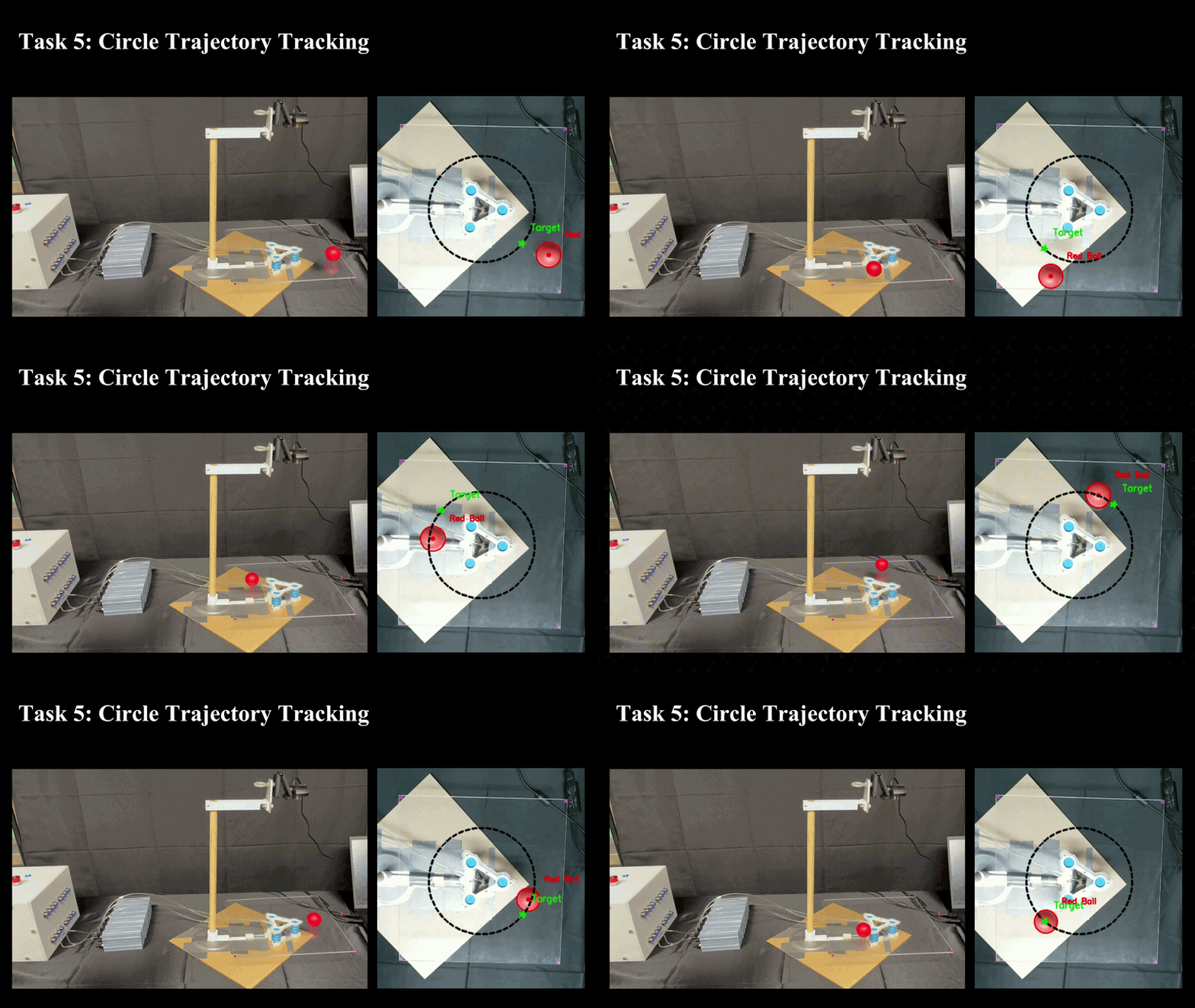
Positive-negative pressure regulation is critical to soft robotic actuators, enabling large motion ranges and versatile actuation modes. However, achieving high-performance regulation across both pressure polarities remains challenging due to asymmetric inflation–deflation dynamics, valve nonlinearities, and switching-induced flow disturbances. This paper presents BiPneu, a compact and cost-efficient multi-channel bipolar-pressure pneumatic system for soft robots that enables wide-range, accurate, and responsive pressure regulation while providing seamless compatibility with high-level software ecosystems. A dual-mode sliding-mode controller (DM-SMC) with hysteresis-supervised mode selection is proposed based on a hybrid electro-pneumatic model. Extensive simulation and experiments demonstrate the superior performance of DM-SMC in tracking step and sinusoidal pressure references compared with both advanced model predictive controllers and well-tuned PID controllers. Experimental results show average absolute errors of 1.44 kPa in multi-step tests and 4.23 kPa in sinusoidal tracking, corresponding to reductions of 11.9% and 35.6% relative to PID control, along with improved control effort, valve switching rate, and transient response. Robustness of DM-SMC is further verified on a bellow actuator with pressure-dependent volume. Finally, BiPneu’s capability is demonstrated via two soft robotic examples, quick ball-maneuvering with a soft parallel manipulator and real-time finite element method (FEM)-based teleoperation of a soft bellows actuator.

2025
- Journal
 Nonlinear compensation of stretchable strain sensors with application to proprioceptive sensing of soft robotic armVedant Naik, Preston Fairchild, and Xiaobo TanSmart Mater. Struct., Feb 2025
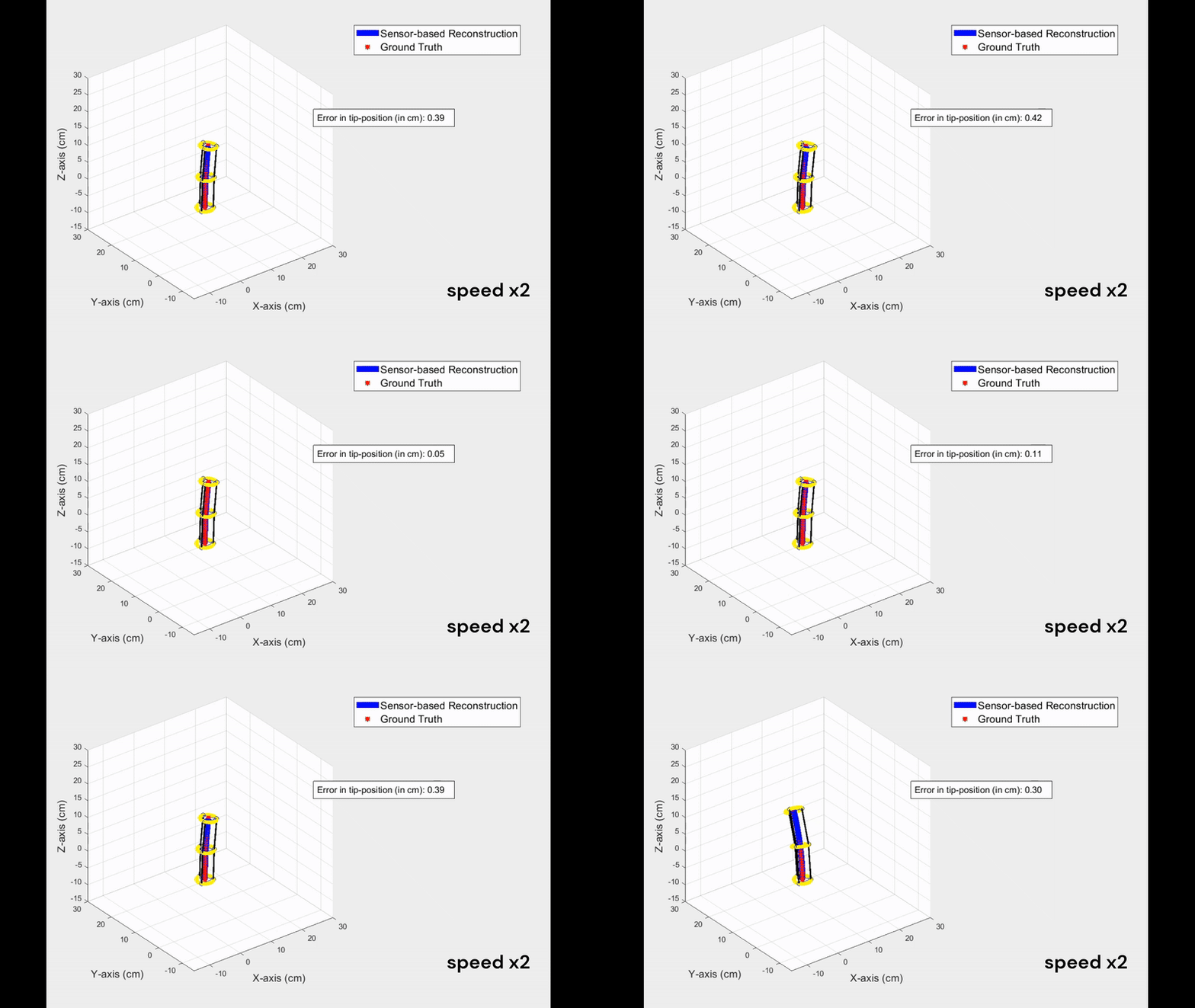
Abstract With advances in materials and manufacturing techniques, recent years have seen a number of conductive composite materials that exhibit pronounced strain-dependent electrical resistivity, allowing them to be used for embedded, cost-effective strain sensing in various applications. The strain-resistivity relationship of these materials, however, is often highly nonlinear and dynamic, posing challenges for effective use of such strain sensors. In this paper, a computationally efficient scheme is proposed for compensating the nonlinear, dynamic strain-resistance behavior of a soft conductive rubber using a Time Delay Neural Network (TDNN). The accuracy and feasibility of the technique is evaluated with a soft robotic arm incorporating three strain sensors for proprioception. Experimental results show that the sensing scheme is able to predict both the tip position and the shape of the robotic manipulator, achieving an average tip positional error of less than 4% relative to the total length of the manipulator.
